Journalism unbound

While researching and writing Thirty-Two Minutes in March, I frequently had to look up game schedules or find sources to verify scores. One might think a logical place to find this information would be Indiana’s largest newspaper, the Indianapolis Star.  But I quickly tired of constantly closing pop-up ads and wading through lifestyle content only to find that sporting events outside metro Indianapolis were largely ignored.

I blame the Gannet-ization of the Star for the deep cuts in local sports coverage. For the past several years, they haven’t even bothered to assign a reporter to the AAA Indianapolis Indians. Anything other than Colts and Pacers doesn’t seem to be a priority. (Which shouldn’t be a surprise, I guess. The Star recently ran a subscription campaign to promote readership and drive sales. Did they tout the number of Pulitzers won? Hard-hitting investigative reporting? High-minded journalism? Nope. They focused on the number of grocery coupons available in the Thursday edition.)

So I found myself relying more and more on John Harrell’s website (indianahsbasketball.homestead.com). The site provides scores, schedules, rankings, and a huge trove of historical data for all of Indiana’s high school teams. Including some that no longer exist. If you ever wake up in a cold sweat and can’t get back to sleep until you figure out the last year Pittsboro won a sectional, John Harrell has the answer. (What? Don’t look at me like that and pretend this hasn’t happened to you.) Several times over the last two years I’d ask a coach a question and be met with “I dunno….you should check Harrell’s site.”

Harrell has operated the website for both football and basketball since its inception over fifteen years ago. He worked as a sports desk editor for the Bloomington Herald-Times for 44 years before retiring in 2011. I asked him how he got trapped into gathering and distributing all this information.

“Back in 1980 Jeff Sagarin came to Bloomington and asked if we (the Herald-Times) wanted somebody to rank high school basketball teams for us,” he says. “And he really needed somebody to chase down scores, so that’s when I became involved.”

Harrell updates all of the scores personally, and usually on the same night as the game. He can frequently be found on Twitter asking for game results from remote corners of the state.

“It’s an everyday job during basketball season. It’s not all day, it’s mostly evenings and then some mornings.                          
dsc_03861

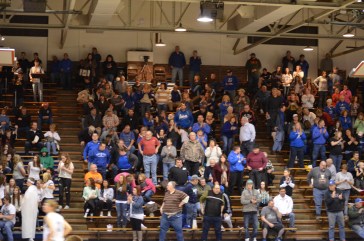
A few fans in Rockville, Indiana

With all the activity on winter nights, I ask him whether he ever gets to actually attend a game.         

“Not really,” he says. “I saw a game at Huntington North (his alma mater) last year . They wanted to say something about me at halftime, and they did. But I had to take a laptop with me to update scores.

“And I saw a game at the Fort Wayne Coliseum on a New Year’s Day when there were only about five games going on. But otherwise, I’m at home updating scores.”

I know that a lot of coaches and fans access the information frequently. I tell him that there were days that I’d look up information four or five times on the same day.

“For football, it’s just kind of a weekend thing. But for basketball, I’ll average 200,000 hits per day. Last December – just for the month –  I had like seven and a half million hits.”

Unlike a lot of other local sports sites (not to mention The Star), Harrell doesn’t charge a subscription fee, and he really doesn’t sell many ads, either. But he doesn’t seem to feel underappreciated. He said that coaches and ADs thank him all the time, and he knows sportswriters rely on his work.

So for very little money, and at a cost of six evenings a week for much of the year, I ask him what his motivation is.

“Just goodwill,” he says. “I worked at a newspaper for 45 years, and it would have been nice to have. And I get a lot of enjoyment out of it.”

I tell him how much I appreciate what he does.

“Yeah, I’ve gotten a lot of recognition,” he says. “It shows you high school basketball is still pretty big in Indiana.”                                                                                                                     
Quick, somebody tell Gannett.

Judging Pete Rose

Growing up in Louisville, Kentucky in the 60s and 70s, almost everybody I knew gambled. Whether it was trips to Churchill Downs, penny-ante poker with the family, or betting football parlay cards, wagering was part of everyday life. I think our civic attachment to gambling is somehow tied up with being a river town. My friends tell me that Pittsburgh and Cincinnati are the same way.

The only person I knew growing up who seemed to have no interest in games of chance was my brother. When my Dad died, John and I were standing around at the funeral home when an elderly man walked up, smiled, shook our hands and expressed his condolences. As he shuffled away, my brother asked “Who was that?”

“Charlie. Charlie Donnelly*.”

“Who’s he?”

I looked at my brother. “Charlie. You know, from the factory. ‘Hots’.”

My brother stared at me in disbelief. “Dad knew a guy named ‘Hots’?”

“Yeah. Hots. You know. Dad’s bookie.”

“Dad had a bookie?”

When my wife and I moved to Indiana, what I found most surprising was the general attitude toward gambling. (Well, that and the complete absence of anyplace serving a decent breaded fish sandwich. But, I digress.) Most of our new friends had never bet on a horse race or a ball game. I started an irregular poker night, and, to this day, sometimes have to verbally repeat the rank of poker hands in the middle of a game.

So I think I understand why some baseball fans think Pete Rose shouldn’t be banned from baseball. When you consider what some Hall of Famers have gotten away with (looking at you, Ty Cobb), merely betting on his team to win as a manager doesn’t seem so bad. Here’s why I disagree.

In a game with tons of unwritten rules, this one is written down everywhere…. I’ve never graced a major league clubhouse, but I’ve been in several triple-A versions. And my understanding is that in every single clubhouse in organized baseball, there is a sign that warns players, managers, and coaches of the severe penalty for betting on baseball. Until just a few years ago, there weren’t any such signs warning about performance-enhancing drugs. So the people who justify Rose by saying “at least he didn’t do steroids” have it exactly backwards. He didn’t get daily warnings about PEDs; but he did about gambling.

I was a part-time usher in a minor league ballpark for one summer, and they told us that we’d be fired for betting on baseball. That’s right….ushers.

Untitled design(2)

Concrete evidence of my lack of wagering acumen. A bet that the Dbacks would win more than 84 games this year. Yikes.

Rose’s claims about only betting his team to win, and only when he was a manager are unconvincing……Rose contends he only bet the Reds to win, and that he never bet baseball while he was playing. I’ve never seen hard evidence that either of these claims is untrue, but I don’t believe them. As much as I love gambling, I know the difference between a recreational gambler and a degenerate. And somebody who is already comfortable risking a lifetime ban is unlikely to set moral standards like only betting his team to win.

And are we really expected to believe that he only started exploiting the edge he had by betting on baseball – a sport in which he was the ultimate insider – after he was done playing? Why would he think it was wrong to bet as a player but not as a manager, especially when it’s thoroughly documented that he was betting on other sports?

Even if he only bet his team to win as a manager, it’s still intolerable…..a manager makes decisions every day that affect the next day’s game. Leave the starter in or bring in a reliever? Is the bullpen shot? Are any left-handers available to face a predominantly left-handed hitting team tomorrow? Do I need to bring up a reliever from the minors and sacrifice a position player spot? What if I’ve bet today’s game at plus-240 and I know we’re probably minus-120 tomorrow?

It diminishes the Hall of Fame when the all-time hits leader and one of the greatest players of the 20th century isn’t included…. OK, this one has some merit, but here’s a solution: lift the ban posthumously. That allows Rose’s singular achievements to be recognized while a) preventing Rose from benefiting financially and b) ensuring that current players don’t assume that they can take a chance (so to speak) and bet on baseball with the hope of getting a subsequent ban lifted.

If Major League Baseball lifts the ban on Pete Rose, the Hall might as well get started on that long-anticipated “Great Players of the Steroids Era” exhibit in Cooperstown.

  • name changed


A Runner’s Life

On Wednesday mornings at the St. Vincent de Paul Food Pantry in northeast Indianapolis, volunteers bag groceries for delivery to the homebound. Workers stand a few feet apart at a row of folding tables and load items into the bags, and then push the bag along to the next person. At the end of the line, a volunteer puts the bags into grocery carts that are wheeled over to the loading dock.

Bill Farney usually takes the end position, pushing the carts into place, reloading the tables with canned goods, and keeping the running count of how many bags have been completed. He’s a tall, trim man with white hair, maybe as tall as six-three, with a ready smile. He’s usually the first worker signed in, often arriving before 5:30 A.M. On this day, he looks up and notices that there’s a shortage of carts. He takes off at a jog to the other side of the warehouse. He brings back several carts at a time, chasing them down when the front cart slips out of line. He makes pretty good time, and he’s not even breathing hard when he gets back to his spot.

Bill Farney is 85 years old.

“I really haven’t (retired),” he says. “But I’m just working part-time, only have a few (sales) accounts left. Then I do the Christmas Tree Store. But that’s only every two weeks.”

He doesn’t mention that he also works one day a week here at the pantry, and officiates high school and college track. I tell him I’m amazed at his schedule, because….you know….he’s eighty-five.

He chuckles and looks down, embarrassed. “Well, if you sit around, you get old.”

Bill grew up in Hutchinson, Kansas, graduating high school in 1949. To be fair, the running part may come a bit easier for him than most octogenarians

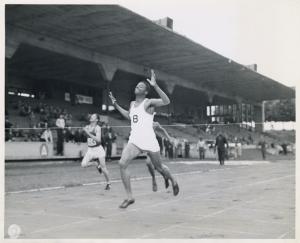
“Back in those days, junior high –seventh, eighth, and ninth grades – were separate from the high school. When I was a ninth-grader, a couple guys in my class were going out for tennis at the high school. So I decided I’d go out for track, and I made the team.

“That year I ran the medley relay and we went to state. I anchored the team. They brought it in first and gave me the lead, and I lost it right away. But the last lap I pulled away.”


nypl-digitalcollections-510d47df-f9b2-a3d9-e040-e00a18064a99-001-r

Bill continued to run track, but also played football.

“I was a halfback,” he says. “I was fairly fast, made a few touchdowns. But I dislocated my shoulder as a junior.

“In those days they didn’t operate on shoulders like they do now. They got a harness for me, but I couldn’t raise my arm high enough to stiff arm anybody. I got by, but that’s why I didn’t go out for college football. (The shoulder) would go in and out all the time.”

(As Bill is telling me this, I realize I’ve been rubbing my slightly arthritic knee. I’m embarrassed to tell him I’ve been laid up for a few days with it. From refereeing soccer. Ahem. Youth soccer. With….um….thirty-minute periods.)

After high school, Farney got a partial scholarship to run track at Kansas. Freshmen weren’t allowed to compete directly against other schools, so they did it remotely. Which means they ran their event on the home track, then telegraphed the results to the opposing school, who telegraphed their own results back. (Which may explain the virtual absence of wagering on freshman college track in the 1940s.)

In his sophomore year at Kansas, Bill ran cross country and the team made it to the NCAA tournament.

“It was the first time I’d ever been on an airplane,” he says. “I was the fourth best runner out of five. We didn’t have a sixth and seventh runner like most schools. We just had five guys, so we all had to finish. But we won our conference, which was the only way to get to the NCAA tournament. For me, that was big time.”

“After sophomore year I ran indoor track, but I developed a throat problem and never could get in real good shape for the outdoor season. My junior year, I just kind of fizzled out. And there were better runners that came along, like Wes Santee.”

(For the record, Santee wasn’t just a “better runner”. He held several world records and won three individual NCAA titles during his career. So it’s not like Bill was replaced by some guy with a bum ankle.)

After college, Bill joined the Marine Corps, got married, had kids, and settled in to a sales career. He kept one foot in track, though, coaching Catholic Youth Organization teams at his parish and officiating. I asked him how he got started in coaching, and he said he took a job assisting at a high school when he was laid off. He got another sales job a few weeks later, but continued to honor his coaching contract. While also working part-time at a hardware store. As an aside, Bill (unnecessarily) adds “So I never was completely idle.”

Being idle doesn’t seem to be on Bill Farney’s agenda. I ask him whether he still runs. I mean, outside of the warehouse.

“Not much,” he says. “I ran yesterday, but only a mile.”

Gulp.

“I’m so slow,” he says. “I exercise in the basement. I’ve got all my used equipment down there. I have a Nordic track, a treadmill, a bike, and a weight bench.

“But I didn’t do anything today.”

A real slacker. It’s ten A.M., and he’s only been at the food pantry loading grocery bags and wrestling shopping carts for five hours.

Break time over, Bill Farney gets up from the table and heads back into the warehouse to finish out his day. Me? I’m going home now. Almost time for my nap.

Drafting dead guys in Fantasy Football: A Rough Guide

In one of the earliest harbingers of fall, the Fear and Loathing Athletic Club Fantasy Football League held its 22nd annual fantasy football draft in late August.

It’s hard not to contrast the current process with the way it all began back in 1995. Back then, we were all parents of grade school kids (almost all boys, for some reason). Approaching middle-age, our athletic skills were racing downhill. We had recently suffered the disgrace of being no-hit in a slow-pitch softball game. In a church league. So we needed some kind of low-cost competitive outlet that required a minimal time investment.

Our early seasons were completely paper-dependent. We bought pre-season magazines and wrote draft choices by hand on a grid. Owners listened to radio broadcasts while driving to the draft, hoping to hear of news of any freak injuries in exhibition games. (Yeah, I said it….exhibition games.) We exchanged lineups via landline and waited for the morning newspaper to get game statistics. As league commissioner, I wrote up the results, added my pithy comments, and delivered copies around the south side of Indianapolis.

But just like stock trading, shopping, and video of kittens and squirrels, the internet changed all that forever. For the last several years, everybody wants power and wifi access on draft night, keeping an eye on late-breaking injury reports and training camp battles.

The draft and pre-draft meeting represent two of the few times each year that we all still get together. (Editor’s note: the “pre-draft meeting” consists of a couple beers at a microbrewery and a minor-league baseball game. Actual discussions of fantasy football are generally frowned upon.)

We still cling to our annual jokes and stories, though. One year in the pre-internet days, Don (owner of the Marian Cyclotrons) actually drafted a dead guy, and that always gets mentioned at least twice.

“OK, your pick, Don.”

“Um. OK. I’ll take…..Fred Lane, running back.”

Stunned silence. Don writes the name down as the rest of us try to avoid eye contact with each other. Somebody starts whistling “Taps”. Should we say anything? We’re Catholics, for crying out loud. Our kids go to the same school, and our wives are out to dinner together right now. Shouldn’t somebody say something? Throat clearing and coughing, a scrape on the tile floor as somebody scoots a chair back. Then…..

“OK.  Jack, your pick.”

Player misbehavior provides a lot of joke fodder. One incident happened fifteen years ago, and it still gets a comment every season, usually when we start drafting kickers in the last two rounds. Oakland Raiders kicker Sebastian Janikowski collapsed at a San Francisco bar in 2001, reportedly after overdosing on GHB (the “date-rape” drug). You can head in a lot of different directions with that one, which probably accounts for its longevity. You can go with a) “stupid football player”, b) “fat kicker”, c) Oakland Raiders player personnel decisions, or any combination thereof.

Like Caddyshack quotes on a golf course, the jokes are dated and predictable, and not even funny anymore. But we all laugh and tilt a beer. It would seem odd not to hear them at the draft. Just like it’d be odd not to hear Charlie mutter “Dammit” every time somebody drafts a player he thought would slip to him in the middle rounds.

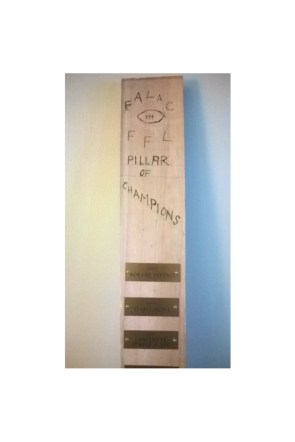
In addition to the nominal cash prize, we award a trophy and championship jacket to the league winner. The Pillar of Champions is a two-by-four that is now warped, but contains a plaque for each champion, along with some ornamentation I added using my son’s woodburning kit.                                                    Untitled design(3)

Much like the green jacket awarded at the Masters, our title-holder also receives a blue, orange and white plaid sports coat. To my knowledge, it’s never been worn, and  probably never cleaned since I brought it home from Goodwill in 1995. It has hung proudly in many hallway closets since then. As long as our wives don’t notice it and demand removal to the garage.

As reigning champion, I had the last pick in the first two rounds this year, taking Julio Jones with the first (retaining him as a franchise pick from last season) and Chargers receiver Keenan Allen in the second. We’ll see how this receiver-laden strategy works out. Just for old time’s sake, I drafted Janikowski in the last round. Keeps the joke alive.

Untitled design(1)

Bobsledding and baseball


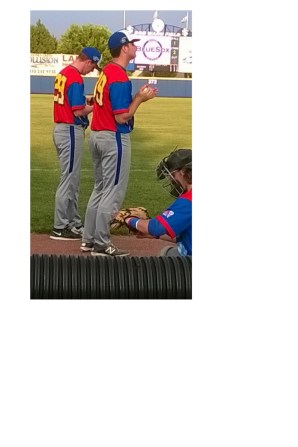
A pitcher warms up in the left field bullpen at Bob Warn Field  on a hot summer evening, but there’s little urgency. The bullpen catcher for the Terre Haute REX makes sure he knows he’s not getting in the game any time soon. Their teammates on the field are taking on the Butler Bluesox in a late-season game in the Prospect League, a summer “wood bat” league for college baseball players.

“They just want you to get loose. In case he starts having trouble,” the catcher says, as he paces around the bullpen.                           Rex bp

There’s a little blond kid, maybe three years old, playing in the dirt beside the chain-link fence next to the bullpen. He’s wearing an Indiana State Sycamores T-shirt, and his dad sits on the wooden picnic table watching him and keeping an eye on the game. The boy starts to toss gravel through the fence. The rocks make it only a few inches inside the chain link, but it’s the kind of thing a parent has to de-escalate. Nip it in the bud. The boy gets a couple of warnings, but then his dad scoops him up and walks off, promising ice cream.

In dozens of leagues across the country, college baseball players extend their season by playing in the summer. College teams use aluminum bats, but in the summer collegiate leagues, players wield wooden bats to prepare for the next level. The Prospect League has been around since 2008, and includes teams from Indiana, Illinois, Ohio, Missouri, Pennsylvania, and West Virginia.

When I first read about Terre Haute’s team, I thought maybe the REX name was a reach for a play on words, trying to draw young fans with a Tyrannosaurus Rex tie-in. But the website has no dinosaur- themed merch or other reference to pre-history.

Bruce Rosselli is part-owner and general manager of the REX.  “Clabber Girl got the naming rights when the team started”, Rosselli said. “They have a brand of coffee named ‘REX’, that’s why we don’t have a dinosaur mascot. They didn’t want their product associated with a dinosaur.”

I got the impression that Rosselli thought it might be easier to market a team with a dinosaur mascot, rather than one related to a brand of coffee sold only within 20 miles of the Wabash River.

And – make no mistake – Rosselli has to spend a lot of his waking hours in marketing. It might seem to be a letdown for a successful athlete to make a living in sales. But, for Rosselli, sales and sports have been intertwined for a long time.

After competing in track and field at Indiana State, Rosselli rose to the highest levels of a different sport. A member of two world championship bobsledding teams, he competed in five Olympic trials and was the alternate driver for the U.S. teams in 1994, 1998, and 2002.

But as an elite level bobsledder from Indiana, his career required marketing. A lot of marketing.

“I was my own marketing guy,” he says. “I went to a bank here (in Terre Haute) in ’86 or ’87 after I started bobsledding and asked for $20,000. Now, I’m in the Midwest, and I’m asking a bank for money for two bobsleds and a trailer. One sled was $6,500 and the other was $8,500, and I bought a used trailer.

“I ended up in 2002 with my last sled costing almost $100,000 to build, and I raised all the money for it. So when I look at what I’m doing now, it’s not easy, but it’s a challenge I can take on.”

Rosselli approaches cutting costs and improving team operations with as much passion as he did his athletic career. Named general manager in 2014, he negotiated contracts with national sponsors for bats and bus travel to cut costs. The team officially uses Titan wood bats and sports uniforms from Adidias, and the field is adorned with new signage from other sponsors.

Rosselli doesn’t have to pay his players; it’d be a violation of NCAA rules. The most he can give them is meal money and hotel rooms when they’re on the road. But other people have to be paid, and operating expenses have to be met. The REX draw about 30,000 fans per season in the abbreviated, June-early August schedule. But a ticket is only five bucks, and concession prices are closer to flea market level than major league baseball.

A professional team may be able to rely on ticket sales and TV revenue to pay the bills. But the REX depend on the support of the local business community, and Rosselli has to come up with new ideas and approaches to get a share of local and regional advertising budgets. Getting the big apparel companies on board is key, but Rosselli has to run down revenue at the local level, as well.

“In 2014, when we (the current ownership group) took over, I had to go out to all of the sponsors and tell them ‘We can’t sustain the team at the same sponsorship level (as in prior years).’ The sponsors were all grateful that we kept the team in Terre Haute, and 85-90% percent of those companies stepped up.”

On this night, The REX are dressed in blue, red and yellow uniforms as part of a super-hero promotion. The jerseys will be auctioned off on the following night, but fans have multiple opportunities over the course of the season to get free stuff.

“Last year I gave away eighteen bikes, two grills, and two flat screen TVs,” Rosselli said. “I can give a sponsor a bike giveaway, let them set up a promotional table, and let the first 500 kids in free, for $1,150.

“I buy the bike, but I have an agreement with Academy Sports and can get them at a discount. The company also gets a quarter-page ad, so that’s a low-cost sponsorship.”

On the field, free bikes and apparel costs aren’t the primary focus. For the hitters, using a wood bat is sometimes a painful adjustment. REX pitcher Eric Sexton is understandably delighted to face hitters with lesser tools. A fastball hit off an aluminum bat comes back to the pitcher a lot faster, even if it’s not hit squarely. A ball that might be rifled up the middle off a metal bat gets fouled off the hitters shin with wood.

Sexton chuckles thinking about it. “Oh, that’s beautiful,” he says. “Hitters definitely have to square up a little more, and, as a pitcher, you get away with a lot more. It’s awesome.

“But these guys are all good hitters, and by then end of the summer they’re used to it.”

The players live with volunteer host families during the season. I ask Sexton whether it’s awkward for a college student to move in with a family in a town he’s never seen before. He grew up in Indianapolis before moving to Florida in high school. Though he’d never lived in Terre Haute, he had at least been here before.

“I played with Ethan Larrison when I was twelve or thirteen, and we’ve stayed in touch. He played for the REX last year, and when I came back to visit family in Indy, I came over to Terre Haute and caught a game last summer. So I decided this would be a good place to play summer ball.

“I’m staying with the same family that Ethan did last year, so it’s been a little easier on me. We started out with a mutual friend (in Ethan), so that made it a little easier.”

The REX may be wearing superman jerseys, but the Bluesox apparently have a bat-supply deal with Kryptonite Industries, and they drill the REX by a score of 20-5. Despite the disappointing result, the crowd seems to enjoy the game. The PA announcer keeps confusing the prior night’s bike promotion with tonight’s back-to-school focus, and the crowd blows him crap in good-natured way. Parents walk around with little kids, trying to manage concession stand costs just like Rosselli does with travel and equipment. Some of the fans in premium seating (twelve bucks) start yelling at players about errors, but then switch to positive reinforcement (“Let’s go REX! Let’s go REX!”)

As the game ends, families and couples file out into the dark, warm night. The Prospect League season is almost over, soon to be followed by the start of football and the first cool days of autumn in Indiana. In a few days, the players will pack up, say goodbye to their host families, and go back to being college students. The little boy is asleep on his dad’s shoulder, head bobbing with every step on the gravel parking lot. Maybe he’s dreaming about baseball. But my money would be on ice cream.


WP_20160804_009


Well, the book is finished. What now?

Over the past two years, I’ve spent many hours researching, writing, revising, and publishing Thirty-Two Minutes in March. I could say it’s been an all-consuming task, wrenching me away from things I’d rather be doing, like charity work, babysitting grandkids, or perfecting my table tennis serve. But here’s a dirty little secret….. I’ve been using it to duck home improvement projects.

When I retired from my real job in 2015, I had already started on the book. Which means I was watching high school basketball games and interviewing coaches, players, and officials. And I was refereeing some basketball. Whenever I got the stinkeye from my still-employed wife Theresa about finally finishing up the flooring project, or touching up a paint job, or replacing the shutters, I had the book to fall back on.

When I heard the garage door open I’d jump up off the couch, change the TV channel from a Bar Rescue rerun to the local news, and try to get the faucet turned on in the kitchen  before Theresa got in the house. She’d walk in, struggling to get in the door with her computer bag, purse, and coat. Dumping her stuff on the table, she’d turn to me.

“So what did you do today?”

“Pretty hectic. Worked on the book all morning.”

“Any progress on the floor?”, she’d ask hopefully.

I’d shake my head and frown in regret as I industriously washed a cookie sheet.

“Naw, just ran out of time. This book and all, you know…”

So now, the book is done. I still have to try to sell it, but that’s mostly  evening and weekend work. How do I fill the days now? I know…..another book! A brand new, shiny project that won’t involve manual labor!

But writing books is hard. Somebody smarter than me once said that writing one is simple; all you have to do is stare at a blank piece of paper until tiny drops of blood form on your forehead. It’s not quite that bad, but still takes a lot of focus and energy. But a blog…..yeah….. a blog.

So here it is. I’ll mostly be writing about sports, but also other things that I hope interests other people. If you’d like an email alert when new posts are….uh….posted….click on the link below. You can also follow me on Twitter or Facebook and see post alerts there. I hope you’ll join me for this ride. Because we all know what a pain in the ass it is to paint ceilings.