“Hello; Comcast? Yeah, I’d like to request you show the Savannah State game.”

As of today, I am a big fan of Savannah State University basketball.

The Tigers play in the Mid-Eastern Athletic Conference, and their coach is Horace Broadnax. If that name sounds familiar, it may be because Broadnax played for Georgetown during the glory years of Hoya basketball, winning a national championship in 1984. After graduation, he want on to earn a law degree, but signed on as coach of Savannah State in 2005.                                        

greetings_from_savannah_georgia_8367061455-2


(Note: all of the following statistical data comes from Ken Pomeroy’s excellent website kenpom.com. If you’re a serious college basketball fan (or a serious college basketball wagering fan), you should go there and subscribe immediately. In addition to all the stats, Pomeroy writes an entertaining blog about college hoops and provides a perspective you can’t get anywhere else.)  

Saying that the Tigers have been defensive-minded under Broadnax is like saying Kentucky has attracted good recruiting classes. Over the past few years, Savannah has twice limited teams to fewer than 42 points – and still lost. They hold the NCAA record for fewest points in a half (four). They’ve accomplished these milestones by slowing the game down to a crawl, ranking 337th in the country in offensive tempo (possessions per 40 minutes of play) in 2013.

But it seems Coach Broadnax has, to put it mildly, had a change of heart. So far this year, they are playing at the second-fastest tempo in the country (82). If they keep up their current rate of three-point attempts, they will set an NCAA record. They rank 345th – out of 351 – in defensive efficiency.

I haven’t seen this team play (though I’m closely following the schedule, hoping they’ll pop up on one of the lesser ESPN channels (like maybe “The Ocho”). But I believe it’ll be like watching a pickup game at the Y, only with D-1 college athletes.

So why is Broadnax doing this? I sent him an email to ask for an interview a couple of days ago, but haven’t heard back yet. The Tigers are ineligible for the NCAA tournament this year due to a lack of academic progress. (There’s only one other school – Alcorn State – suffering this penalty in 2016.) So maybe he thinks this is a throwaway year, and he might as well experiment with a 180-degree change in his philosophy. It could be that he’s using it as a recruiting angle for future seasons; “Hey kid, look at all the freedom I give my players!”        

But the old CYO coach in me thinks it’s just fatigue. It’s hard to get kids to work on defense. It’s kind of boring, and, in today’s immediate-gratification society, you don’t see the benefits of the other team missing shots until the end of the game. Casual fans often don’t appreciate the work on the defensive end; many would rather watch their team lose 88-86 than see them win 56-50. And you’re not getting on Sportscenter by working your way into good position, cutting off a drive, and making your man pass the ball.

So I wonder if Broadnax just said to himself, “I don’t need this. I’m working my ass off every day, trying to make these kids focus on the right things, and for what? So we can play in the MEAC tournament, get on ESPN 3 for the Tuesday morning final, then go home even if we win it? Let’s put up shots, let the kids have some fun, and get through this dismal season”.

In their last game, the Tigers scored 59 points, but gave up 128 to Oregon. Their next contest is December 11 at Oregon State. They’re not on the ESPN schedule, but sometimes games get shifted around. Still hoping to catch my Tigers on the Ocho.  

*****

A couple more book promotion events coming up:

On Monday, December 12 I’ll be on the radio at about 11:30 AM with Coach Ron Hecklinski on Indiana SRN sports talk radio at http://indianasrn.org/. Even if you’re tired of hearing me talk about the book, it’s always fun to hear Coach Heck. He’s the best!

On Tuesday, December 13 I’ll be on WCSI Columbus (1010 AM) at 8:30 AM to talk about the book and the signing on Thursday at Viewpoint Books in Columbus.


Enough with the sports commentary; let’s talk leaf blowers

I’m often accused of being a cranky old man. Sometimes, the charge is not entirely without merit. But on this one issue, I’m not angry, just mystified.

Why does my leaf blower have more than one power setting?

I can’t imagine any circumstances under which I’d find lower power useful. If I have to use a leaf blower, I’d like the chore to be over with as soon as possible. It’s hard for me to envision standing in the yard during a bright, sunny, autumn day, wearing a flannel shirt and blowing leaves as slowly as possible as a wisp of smoke from the chimney curls up to the cloudless sky. I mean, I’m not making a Lowe’s commercial here. I want to dispatch these leaves quickly so I can get back to the couch.

All I can figure is that the manufacturer put the lower setting on there to make me think I’m getting more power than I really am.  

Scene: A large, windowless room, filled with electrical equipment and tools, parts of lawn mowers, snow blowers, and tractors lying inert on brightly-lit tables, each with an electrical engineer in a white lab coat and safety goggles peering intently at its insides.

Suddenly, an obese, middle-aged man in a brown suit bursts through the double doors, leaving cigar smoke, a secretary, and a vapor trail of impatience in his wake.

“Peterson! Peterson! Where’s Peterson?”, he barks. One of the lab coats turns and tentatively raises a gloved hand.

“Um. Right here, sir.”

“Peterson!” The big man wheels in the aisle, knocking a can of lubricant off a table, and races over, taking long, quick strides.

“It’s almost June, Peterson! We need to ship the new Articulated Scoop N’ Suck Leaf Blowers by July! Where are we?”

“Almost – almost there, Mr. Spacely”, Peterson stammers. “Last step is this power switch, then it’s ready to go to production.”

“Hmmph. Hmmph,” Spacely grunts. He yanks the leaf blower away from Peterson, knocking a glass beaker to the floor that shatters. A long-suffering maintenance man walks over with a broom as Spacely turns the blower upside down, right side up, then sideways.

“How many power settings does it have?”

Peterson looks at him quizzically. “How many? Well, um, just the one, Mr. Spacely. We call it ‘On’”

“One!? Are you kidding me, Peterson? How are we going to sell leaf blowers with only one setting?”

“Well, market research tells us nobody ever uses anything but maximum power anyway, sir. And besides, it’s already blowing 600 cubic feet per minute. That’s enough to knock a passing paperboy off a Schwinn.”

“Dammit, Peterson! The actual performance has nothing to do with it! We’re not selling the steak, son; we’re selling the sizzle! What self-respecting suburbanite is going to stand around the gas grill on a Saturday and brag to his neighbors that he has a leaf blower with one setting? That guy’ll be running to the drugstore to fill his Viagra prescription in minutes! He’d be a laughingstock, boy, a laughingstock!

“Now here’s what you’re going to do, Peterson. You’re going to add a lower power setting to this thing ASAP. We’re going to call the lower setting “High” and call the regular setting “Road grader”. Got it? ABC, Peterson, ABC. Always be closing.”

Spacely jams his cigar back in his mouth and turns away quickly, his suit coat knocking a can of soda off a table as he bulls his way out the door. Peterson turns glumly back to his work.

“Well,” he mumbles to himself. “I’m glad I didn’t show him the Breast Cancer Awareness model.”        

*****

Now that we’re getting into basketball season, the signing events are picking up for Thirty-Two Minutes in March. On December 2, I’ll be signing and selling copies during the Southport game at Center Grove.

On December 10, I’ll be at the Southport Shootout for most of the day at the fabled Southport High School Fieldhouse. It’s the tenth largest gym in the state, seating over 7,000. Southport has put together a strong lineup for the day. I’m looking forward to seeing Romeo Langford (probably the 2018 Indiana Mr. Basketball and a high-level D-1 recruit) in person. The schedule is:

Castle vs. Mt Vernon (Fortville)………………………..12 noon

New Albany vs. North Central (Indianapolis)………..2:00 PM

Cloverdale vs. Park Tudor……………………………4:00 PM

Fort Wayne Snider vs. Hamilton Southeastern……..5:40 PM

South Bend Riley vs. Southport………………..…….7:20 PM

Return to Center Grove

One of the teams that I focused on in Thirty-Two Minutes in March was Center Grove High School and their first-year coach, Zach Hahn. He was a head coach in one of the largest    schools in Indiana, and only three years removed from playing in the NCAA championship game for Butler University.              1478887301___coachhahnwatchesthetrojansatpractice                                                

Whenever we spoke, two things stood  out. First, that he was a very intense young man. Second, that he was totally committed to building the Center Grove program for long-term success.

A few weeks ago I interviewed him again during an early pre-season practice for 2016-2017. Neither of my previous impressions have changed. Hahn is still all in on growing Center Grove basketball, and unrelenting in his belief that the Trojans can compete with anybody. But even Hoosier-state legends age over a couple of years, get a little older, a bit wiser, and more introspective.

“I’m working harder on reflecting more after games,” he said, with the sound of bouncing basketballs echoing off the rolled-up bleachers in cavernous Vandermeer Gym.”They all say ‘Coach, don’t criticize’, and there have been some times when I criticized more than coached. I need to do a better job of that.”

As I watch practice, I notice that the assistants are a lot more involved in the drills, instructing players, making their voices heard. Two years ago, Hahn never would have walked away to talk during a practice. Now he mostly stands or squats on the side, watching intently, only jumping in periodically to emphasize points or make observations. He’s only lost one assistant coach over the first two years, so they all understand what he wants.

As we stood on the sideline, Hahn spoke at length about the season and his players, but his eyes rarely left the court. “I can come over here now,” Hahn says. “I can watch the big picture while the assistants run the drills.”                      coach-hahn-makes-a-point-during-practice

He’s also made wholesale changes in the Center Grove youth league, binding it more tightly to the high school program.  

“We run the evaluations for the youth teams now, and we pick the travel teams. Those guys are all a big part of what we do. The middle schools are much more involved now. Last year we hired a middle school liaison to help teach them our systems. I think people are excited about our program, because they see not only me, but our players and coaches out in the community, doing things like going out and watching youth league games.”

In his first year, Hahn said there were times when he thought referees were trying to set a tone and let a young coach know that he couldn’t get calls by being loud and assertive. He was consistently vocal with referees, but got only one technical foul all year. I asked him whether he noticed any difference last year with a full season under his belt.

“I’d say it was the same,” he said drily. “A lot of guys just want to come in and make sure I understand it’s gonna be what they want and not what I want. That I’m not going to dominate the game vocally. And that’s another thing I’m working on as a young coach who’s fiery and pretty passionate. I’ve got to adjust my coaching a little bit when I deal with referees.

“But I think the players this year have done a really good job of adjusting to me. It hasn’t always been that way. I think these guys are a little more tough-minded.

“It’s their third year with me now. After my first year I lost seven seniors, and we only had a couple of guys coming back with any varsity experience. We had three freshmen in our top eight last year. This year we have six guys coming back that will play in our top ten. So they have a better understanding of the process and how things work day in and day out.”

In that first season, Hahn was concerned about scheduling, especially on weekends with games on both Friday and Saturday nights. He couldn’t eliminate all of those scenarios due to the five-year lead time needed to change conference schedules. He’s got three weekends of Friday/Saturday games in December. And in January he’s got two very good teams – Ben Davis and Roncalli – on back-to-back nights.

Hahn shakes his head. “That’ll be a bloodbath weekend. That’s a very physical weekend for us.”

But he has had some effect on the schedule.

“We got rid of New Palestine and picked up Avon, who is more like a sectional opponent. We picked up Southport and got rid of Cathedral to try to create a south side rivalry. We didn’t make the schedule any easier, but we’ve created a level of play that we want to maintain all year.”

Hahn won’t project an expected number of wins. But he thinks Center Grove can compete in the powerful Metropolitan Interscholastic Conference. And as Assistant Coach Brian Keeton once said, “If you can compete in the MIC, you can compete with anybody in the state.”

pre-season-practice

Ref for life

Bob White is no longer a licensed referee in Indiana. A car crash robbed him of his mobility and cost him years of pain and physical and mental rehabilitation.

But as he sits in his wheelchair at the center line of a basketball court at the Keenan-Stahl Boys and Girls Club on the near south side of Indianapolis, he looks happy, like he’s in his element. He’s refereeing a basketball game, with several excited eight-year-olds running up and down the court.

“That’s the first time I’ve refereed since the wreck,” he says. “It was fun. Even though it’s just little kids, it’s the first time I’ve put the (striped) shirt back on.”

He laughs. “That shirt is from 1998. It’s the only one I still have.”

Bob officiated for over twenty years, working high school, college, and semi-pro football, along with high school basketball and baseball. He was a founding member of the Crossroads Officials Association, and actively worked to mentor new referees. Even after he was a seasoned varsity official, he’d occasionally work freshman and JV games alongside novice referees to help them develop.

But eleven years ago, that all ended suddenly when he was in a car crash in Indianapolis. Right after umpiring a baseball game.

“I had just gotten married about six months before the wreck,” he says. “I was working in the pharmacy at Community North Hospital, but I sold my house and we moved to West Lafayette.

“I found out a week before the wreck that my wife was pregnant. A friend of mine in Whiteland was having a cookout. My wife was in the car behind me and witnessed the whole thing. A lady T-boned me who was texting, and she didn’t have any insurance.”

Bob was in the hospital for months with traumatic brain injury, almost died a few times. After that it was years of rehab.

“After I got home, I was still doing rehab three times a day. I had to re-learn how to talk, how to eat, everything.

“And then, five years ago, my wife divorced me.”

Bob is 100% disabled from the crash. He says he was angry for a long time, but he gradually decided not to spend the rest of his life in self-pity. He threw himself into service to the community, accepting presidency of the Boys and Girls Club, working at the food pantry, and organizing sports and activities at the club. Making other people happier, healthier, and safer.

“I just try to be positive every day when I wake up and think about the things I can do rather than the things I can’t.

“It makes you feel good to help out. Some of the kids appreciate it and some don’t. But I went to the club as a kid. Sometimes we forget where we came from.

“I really miss being around kids and refereeing. At least at the club, I’m around the kids.”

“(Referees) get yelled and screamed at, but we’re going to protect each other. We’re the only ones that have each other’s back.

“And what better place to be on a Friday night than Southport Fieldhouse in front of five thousand fans, smelling the popcorn, hearing the band play, and you’re in the referee’s dressing room, all fired up like you’re going out there to play.”

During his convalescence, Bob got a lot of support from his officiating crew and other referees.

“People don’t realize that referees are a small fraternity. The ref community came together for me. They bought me an accessible van, really stepped up and took care of me and my family. It was pretty eye-opening.”

As I sit with Bob in the bleachers at the Club, he’s a bit annoyed. He scheduled a basketball tournament for this Saturday morning and got eight outside teams to commit to playing. He even verified the schedule with the coaches over the last few days, or at least attempted to with some who didn’t return his calls. Not one of them showed up. He’s left with two half-court games for the Club kids. They have to play short-sided to keep the age range reasonable. Next to the court sits a pile of prizes donated by local merchants. Bob spent a lot of hours driving around to various businesses, hustling donations for the Club and promotional items for giveaways.    

dsc_0701-1

An empty gym. In Indiana. In November.

I’m not sure how I’d deal with this kind of frustration. But I can’t help but admire how Bob does. He says he’s going to start on next year’s event earlier, find some way to get other teams to show up. He plans to start making contacts this month.

As I stand to leave, he asks me whether I’m busy the day before Thanksgiving. He’s looking for more volunteers to work at a community dinner that day at the food pantry.

Pro football: Not doomed, but has a bad cold

nfl_jets_at_dolphins-sun_life_stadium-2012-09-24-1

A few years ago Dallas Mavericks owner and IU alum Mark Cuban made some waves with comments about the NFL. In an interview on ESPN and a detailed Facebook post, he said the NFL is “doomed” in the long run (which he implied was about ten years). He said that the problems were oversaturation, declining youth football participation rates, player behavior, changes to broadcast TV, and fantasy football.

A lot has happened in the intervening three years. I agree that the first four are a problem, but I do think he misunderstands the appeal of fantasy football. He seems (or seemed at the time) to think that FF is entirely technology-dependent, and people will move on to other pastimes. As I’ve written in this blog before, that certainly hasn’t always been the case. And rotisserie baseball leagues are still going strong, and pre-date fantasy football.

If I were making Cuban’s argument, I’d add that the NFL product these days is virtually unwatchable. Three plays. Punt. Commercials. Two minute drive ends at fourth and long. Commercials. Field goal. Commercials. Replay challenge. Commercials. Kickoff. Commercials. Etc, etc. etc…..

It’s telling that the NFL season package includes an option to watch any game shortened to 45 minutes. 45 minutes of action from three and a half hours of TV time. And some people think baseball is boring?

I like sports. I like watching baseball, basketball, soccer, horse racing, college football, and even hockey on occasion. And I do watch the Indianapolis Colts, if only to keep up with my friends’ conversations. But if I’m watching NFL football, odds are I’m also doing something else, like reading or keeping up with my fantasy players. There are just too many stoppages of action and players standing around to hold my full attention.

But I don’t think the NFL is going away anytime soon. Not because the games are so compelling, or people are so loyal to their teams. It’s because NFL football is an especially good vehicle for gambling.

Compared to the other mainstream sports, the NFL plays relatively infrequently. With only 16 regular season games, bettors have plenty of time to think about the bet, absorb new information, and chase down rumors. If a star player takes a fastball off his wrist in tonight’s baseball game, you have a only a brief window to find out if it’s something serious. In the NFL, they have daily practice reports leading up to the next game six or seven days later.

Since the NFL has the least effective union in pro sports, players in their prime almost never change teams, so season-long totals bets (i.e., wagering on the total number of wins) are less dicey. And the bettor doesn’t have to factor in the value of a player changing teams for a single-game wager in mid-season.  

Key numbers (most notably three and seven) are much more important when betting football than other sports. Between 2003 and 2013, over a third of all NFL games were decided by exactly three, seven, or ten points. Which is why you see a lot of point spreads hovering within half a point of those spreads. In contrast, the top three key numbers for NBA betting are 7, 5, and 6. Only about 18% of all games end on one of those. Reliable key numbers tease the bettor into thinking that half-point on one side of the line means a payday.

The NFL has also escaped any major point-shaving scandals. Players shooting it out in strip club parking lots? Sure. DUIs, domestic violence, and drug use? Obviously. But nobody fixing games. At least none that have come to light. The worst gambling scandal to touch the NFL was Paul Hornung and Alex Karras betting NFL games back in the early 1960s. (Naturally, Hornung was a Louisville kid. Man, I love my hometown.)

So bettors may have a little more confidence that the games are played on the up-and-up. (There is, of course, the opposite view.  If it was announced a particular horse race was fixed, you’d set records for the amount of money wagered, with every horseplayer in the country figuring he or she could dope out who was most likely to throw the race. But horseplayers are a different breed, anyway. Most accept corruption as an essential part of the experience, and only get frustrated at how much the state or city takes off the top in taxes.)

The American Gaming Association estimates that 90 billion dollars will be wagered on college and pro football this year, with only 2 billion of that bet legally at Nevada casinos. The rest will go to offshore sports books, pools organized at fraternal/social organizations, or Slick Sid down at the neighborhood tavern. And that total doesn’t even include the explosion in daily fantasy sports, which were in their infancy when Cuban made his case.  

So I think Cuban’s estimate of the NFL lifespan is wrong, because he either doesn’t understand or doesn’t want to acknowledge the importance of wagering to the experience. Daily fantasy sports might die out, because all the suckers will get tired of losing money to the consortiums (consortia?) who use private servers and compete as a full time gig. But I don’t see straight wagering going anywhere. NFL football dominates television on Sundays, and betting is the only thing that makes it bearable.

*****

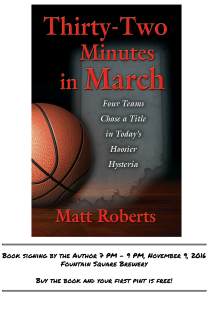
Another signing event. In addition to the book release party on November 9 from 7 PM – 9 PM at Fountain Square Brewery (1301 Barth Ave., Indianapolis), I’ll be signing at Indy Reads Bookstore on Sunday, November 13 from 2 PM – 4 PM. The bookstore is a non-profit (as am I, though not intentionally) and a portion of all sales there will go to Indianapolis literacy programs. So your choice: a free pint at the party, or a worthwhile charitable organization at Indy Reads (911 Massachusetts Ave, Indianapolis). Or both! I won’t judge.


061123broncos-chiefs02

Photo by Conman33

With regrets from a former Cubs fan

Don’t know if you’ve heard, but the Chicago Cubs have made it the all the way to the World Serious. That news would have been cause for great celebration around my house fifteen or twenty years ago. I didn’t really even follow baseball until I started watching Cubs games in the afternoons around 1980. I’d get home from work at 3 o’clock, and Theresa wouldn’t be there until after five. So with no kids to tend  and nothing but soap operas and the Cubs on TV, I started watching Milo Hamilton, Vince Lloyd, and Lou Boudreau on WGN.

After a few years I became a big enough fan that I half-seriously tried to talk Theresa into naming one of our sons after Andre Dawson. He’s still one of my favorite players of all time, signing a blank contract for one year with the Cubs, then going out and clubbing 49 home runs. Now THAT’S believing in yourself.

On several occasions I made the trip north with my Dad (and sometimes my brother) to catch a weekend series. Tickets were easy to get, and it was fun to sit in the sunshine and watch a game. Over the years, I took my sons up a few times. Once I missed three Dawson homers because I 1) took Sean to the nurse’s station for a bee sting, 2) took Andrew to the restroom, and 3) fetched beers for myself, Dad, and Dad’s friend Rudy.

v__88ee

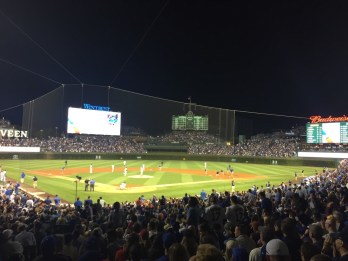
One of these scoreboards is not like the others.

Eventually, I drifted away from the Cubs. I started covering AAA Indianapolis Indians games on a semi-regular basis, and when players were promoted to the big leagues, I’d keep following their fortunes. It helped that most of the future Pirates seemed to be good guys. When my sons Conor and Eamon were Indians’ batboys, Eamon once accidentally dumped Gatorade all over Andrew McCutchen. Cutch just laughed and told him it was no big deal. One player offered to pay for the boys’ tuition at his baseball camp. Another time we were in Pittsburgh for a game, and Virgil Vasquez and Garrett Jones had just been called up to the major leagues. We happened to see them in the hotel, and they remembered Conor and Eamon from Indianapolis and chatted with them for awhile.   

I’m also a Diamondbacks fan, but have no heartwarming stories about them. I just went to a lot of games one summer when I was working in Phoenix.

See? Not heartwarming at all. Told ya.

Despite leaving the Cubs for other teams, I thought I’d always love Wrigley Field, no matter what team I was rooting for. Besides the hole-in-the-wall taverns and restaurants that surrounded the place, it’s in a real neighborhood. As much as I love PNC Park in Pittsburgh, you’d have to walk thirty minutes to find an occupied residence. Around Wrigley, there are actual urban houses four times as tall as they are wide, with front porches where a guy can sit after work with a cold one and the newspaper. Right outside the left field wall is a fire station, and I remember radio broadcasts being interrupted by sirens. I always felt like Wrigley, more than any other ballpark, was woven into the fabric of the city, and had been for a hundred years.

This September, on a sunny, cool day, I met up with my sons Sean and Andrew to take in a Sox-Cubs doubleheader. First, we took the red line train down to U.S. Cellular Field to watch the White Sox against Cleveland. With the Sox out of contention, great seats were cheap. The beer selection was outstanding, and we lucked into a compelling 2-1 game with Chicago plating the winner on a walk-off hit.

Then we took the train back to the North side, where the Cubs were playing a night game with a chance to clinch the Division. We got there about an hour before first pitch and waded into blocked-off streets choked with pedestrians. I’m pretty sure the average blood alcohol level approached double digits.

A lot of the small businesses – bars, souvenir shops, restaurants – have been cleared away by new construction. My Chicago-based son told me that Cubs, Inc. had been aggressively buying up property around the ballpark and plan new offices and a “plaza”. I was disappointed, but not especially surprised. There’s no law requiring team owners to be less avaricious than your average ticket scalper.

We entered the ballpark to jam-packed concourses and long lines for concessions and restrooms. Again, nothing new. It’s an old ballpark. Fans didn’t expect swimming pools and playgrounds at a baseball game (or rather, in the vernacular of the time, “base ball”).

So I wasn’t annoyed at narrow-gauge seats (some with a partially obstructed view), crowded concourses, and cramped restrooms. But when I get all the old-timey inconvenience, I expect the object of attention –  the field – to continue the theme.

Instead, what I got was two gaudy, low-definition video boards with muddy sound. I don’t even think the primary purpose of Cubs, Inc. was to enhance fan experience. They just wanted to block the view of people who own the high rises across the street.

The beer selection was unworthy of a college wood-bat team. Budweiser, Miller Lite, and Blue Moon were about it. Unless you consider Old Style a craft beer.

So Cubs, Inc. apparently finds itself bound and gagged when it comes to giving fans a better experience. But when it comes to wringing more cash out of this nostalgia business and running everybody else out of the neighborhood to increase ROI, they’re freewheelin’, hard-chargin’ entrepreneurs. The Cubs lost to Milwaukee that night, but backed into the Division crown when St. Louis lost a few hours later. Which seems about right.   

So congratulations to all the Cubs fans, and good luck against Cleveland. I hope the Cubs win, but only because of my long-held resentment against the abomination that is the designated hitter rule. The team lost me through no fault of its own. Wrigley lost me by trying to be two things at once, and doing neither particularly well.  

v__802e

Cubs fans rising in anticipation of another beer.

Speaking of shameless commercialism…I have a couple of book events coming up:

Book release party….I’ll be signing (and, hopefully, selling) copies of Thirty-Two Minutes in March at Fountain Square Brewery, 1301 Barth Ave, Indianapolis on November 9 from 7 PM-9 PM. Buy a copy of the book and I’ll buy your first pint of tasty craft beer. Or, just come have a beer, listen to some jazz and make it look like I have friends.

Indy Author Fair….on October 29 at the Indianapolis Central Library I’ll be joining dozens of other Indiana writers from 12 noon – 2 PM, signing and selling books. There are also a lot of talks by successful writers and writing workshops, all for free. See http://www.indianaauthorsaward.org/indy-author-fair for details.

You oughta write a book

I used to think that if you published a book, you could count on spending a lot of time in limousines going to interviews, attending signing events, and leveraging studios against each other for the movie rights. In my case, I think I’d insist on filming the the whole thing in Aruba. A really creative director could overcome the obvious obstacle that the book is set in Indiana.

But when I started researching the marketing process, I quickly found out that unless you’re already famous, most of the responsibility for selling books falls on the author. Actually, since Thirty-Two Minutes in March was produced by a print-on-demand publisher, all of the responsibility falls on me. But friends who’ve worked with traditional publishing houses tell me their marketing support is minimal. The publisher might set up a couple of signing events and send out a press release, but unless you’re John Grisham or Lady Gaga, you’re mostly on your own.

(Note to self: email Lady Gaga about ghost-writing her autobiography. If successful, insert obscure references in the text that make fun of Purdue basketball.)

It’s hard to fault the publishing companies for their lack of support. There are something like a million books printed every year. If they aggressively marketed every product, they’d need thousands of salespeople for the effort. And books aren’t the primary entertainment source they used to be, so each tome competes for an ever-shrinking audience.

Pete Cava has two books out through traditional publishers, and while I was writing the book we met for lunch a few times so I could get some advice. Every time we discussed marketing, Pete would pause, look over his glasses at me and say “Matt – you gotta put yourself out there.”   

For a closet introvert like me, this doesn’t come easily. (A closet introvert being somebody who is embarrassed about being an introvert.) I went to one of Pete’s signing events, and he graciously introduced me to the owner of the store and told her about my book. She gave me a business card and asked me to email her with the details. I just nodded, said “OK, I will. Thanks.”

When we were out on the sidewalk, my wife Theresa turned to face me.

“Why didn’t you talk to her and tell her about the book? She was interested. You could have set up a signing right then…”

She’s right, of course. I’m just not used to selling a product, especially on the spur of the moment. And I’m probably overly sensitive to rejection. It’s easy for me to talk to dozens of people in a group setting and make jokes about buying the book as a shower gift. It’s much harder to stick out my hand, smile, make eye contact and ask a stranger to fork over $18.95 or make arrangements for me to hold an event.

The good news is that I’m getting used to it. I’ve found that I get a little jolt of satisfaction every time I sell a copy. Especially when a stranger buys one. Not that I don’t appreciate the family and friends who bought a copy. It’s just that I feel like they’re mostly doing me a favor. But when a stranger buys a copy, I mentally note a reduction in the gap between my costs and sales, and it really buoys my spirit.

My publisher (booklocker.com) provides authors with a 90-day plan for marketing books, which has been a big help. My family has also given me some great ideas.

Theresa suggested holding an eventfeaturing-the-center-grove-trojans at a coffee house near one of the schools, and I’ve set that up. My son Conor suggested a book release party at Fountain Square Brewery (where my son Patrick works), and that’s now on the schedule. (Buy a book and get a free pint of craft beer!) I’ve got other events at various stages of development, and I’m sure at least some of them will pan out. It’s gradually getting easier for me to “put myself out there”.

When I was getting started on this project, I told myself that I didn’t really care about sales. I was writing the book for my own satisfaction, and publishing it as a retirement gift to myself. Just seeing the thing in print was enough for me, and if, by chance, I sold enough copies to break even, I’d be gratified. As long as I could somehow arrange a tax-deductible trip to Las Vegas. (See you at the Nike Basketball Coaches Clinic in April!)

But it’s gradually become more important to me to sell copies. And it’s not even mostly about the money. I think it’s more about overcoming my reluctance to engage strangers and developing new skills as I age. Like Bill Farney said, “If you sit around, you get old.”

Under the mentor’s watchful eye

In 1993, Ron Hecklinski replaced Indiana Basketball Hall of Famer Norm Held as head coach of the Anderson Indians. Held had won over 300 games, including five semi-states and ten sectional championships in his time at Anderson. By the time Coach Heck retired in 2011, he had won 273 games, five more sectionals and a regional championship.

Hecklinski coached the Indians during the final season of Indiana single-class basketball in 1996-1997 while recovering from a liver transplant. His journey was documented as part of William Gildea’s excellent book about that time, “Where the Game Matters Most: A Last Championship Season in Indiana High School Basketball”.

I meet with Coach Heck on a blistering day in August, when basketball season seems especially far away. Since his retirement he’s done a lot of things to keep busy; coaching consultant, volunteer assistant coach, and broadcasting. He’s happy with his life, but misses the heat of competition.

“I do miss being a head basketball coach,” he says. “In a game situation, when you’re in that huddle and you have ten sets of eyes staring at you, wanting you to tell them what to do….that’s a powerful feeling.

”I’ve looked at a couple of jobs – Park Tudor, Cathedral. I’m sixty years old, but I still have the juice to do it. So maybe if the right opportunity comes up, I’ll be able to do it again.

“I miss the leadership, and having an influence in kids’ lives.”

I ask him about the differences in coaching now, compared to when he started.

“In Indiana, when I first started coaching, we did whatever Bob Knight did. Anything Coach Knight said was what we did. Whatever he said was golden, and he said that motion offense was it. Motion offense and screen away from the ball.”

And, of course, man-to-man defense.

“Zone defenses are a lot more prevalent now. I actually like sequencing defenses, where you play one defense on a made basket, and something else on a miss. But if you’d asked me in mid-career, I never would have played a zone. I mean, what if Coach Knight comes to watch and sees me in a 2-3 zone?”

Hecklinski may have been safe risking the occasional zone at Anderson, but before he got that job he served as head coach at Edgewood High School, just a few miles west of Bloomington.

“When I was coaching at Edgewood, Coach Knight used to come to see some of our games, because his son Pat played at Bloomington North. He always told me, ‘Man, your defense is really good.’ So why would I ever play a zone?”

Like any Indiana kid, Hecklinski was flattered by the attention from “The Mentor”. But it could be unnerving, too. Asked to coach an AAU team Knight put together, Heck had to practice and play the team under the watchful – if not intrusive – eye of Knight.

“Try running a practice with Coach Knight there. He’s just yell stuff out. “Ronnie! What are you doing? Get that guy wide down low!”

Hecklinski also shared a reputation with Knight for being hard on officials.

“People say I got on the officials, but it was never really my fault,” he says. It was Gene Cato’s fault.”

Cato, Indiana High School Athletic Association Commissioner, was also a former basketball coach.

“My first year of coaching I got a call from Gene because I got four technicals in my first four games. He calls me and says, ‘Coach, I just wanted to call and tell you that you’re now second in the state in technical fouls.

“I said, ‘Mr. Cato, who’s in first?’ He said, ‘Bill Harrell at Muncie Central.’

“I said, ‘Give me a week and I’ll catch him.’  

“But when I was younger, I did get a little carried away,” he says. “As I got older, I always knew when to stop.”

Which begs the question: do coaches get technical fouls because they’re really angry, or is it a way to drive player and/or referee behavior? Nature or nurture?

Heck thinks for a while as he sips an ice water. “It’s probably fifty-fifty. I never said (to a referee) ‘Give me a T’, but maybe your team is a little sluggish, and maybe you’re getting hosed a little (on calls), and you want to get your guys fired up. And, 90% of the time? It works.”

As Hecklinski walks out of the restaurant, the late afternoon sun is shining through the front door. It might be the late afternoon of his career, too; but after thousands of games and practices, he probably doesn’t worry about Coach Knight’s opinion much.


A protocol for referee-baiting

I’ve been officiating soccer and basketball for a few years now, so I think I’m qualified to offer a few recommendations to fans who enjoy screaming at officials.

First, let me assure you that I have no expectation of rehabilitating the great mass of unruly fans who regularly engage in ref-baiting. Loud verbal criticism of officials happens all over the world, and there’s a long list of incidents where soccer referees were even physically attacked back to the late 19th century. So yelling at the official has deep roots that pre-date these coarsened times.

It’s easy to see the officials as anonymous striped shirts, so when things go wrong for your side, blaming the ref is a pretty facile reaction. But it’s unlikely the referee woke up, showered, and, while shaving, thought “Hmmm. I think I’ll screw the home team today, keep things interesting.”

Now I don’t mean to make excuses; we are getting paid for our effort, after all. But I know that I’ve missed calls even after diligently studying the rule books, working hard to get into position and focusing on the play when some kid runs through my field of vision at the wrong moment. I can’t call what I didn’t see. You don’t have that issue from the stands. Unless you have the guy in your row who gets up in the middle of a play to go for nachos. (Or to address the inevitable outcome of nachos. Not to be indelicate.)

Having said all that, I would like to make a few observations for your consideration before you attend your next sporting event. Maybe you’ve already thought of them, but I think a lot of people haven’t.

  1. Don’t yell about a violation unless you’ve actually read the rule

A friend of mine was ejected from a third-grade kickball game for arguing a rule that he had made no effort to understand. He just thought it was wrong that a kid on the other team did something. You might think “Well, that guy’s just an idiot.” (Which would be a reasonable assumption, considering that he’s a friend of mine.) But it goes on all the time. Whenever I’m working a basketball game and a shot is tipped three or four times in the lane, somebody in the stands will start screaming “THREE SECONDS! THREE SECONDS!”  (The three-second count resets on every shot, sir.)

It’s not that this comment distracts me. If I even hear it – being focused on other things at the moment – I think it’s kind of funny. But somebody sitting close to that guy probably does know the actual rule, and he has to sit there trying to tune out this loudmouth yelling about something he doesn’t understand. So don’t be that guy.

2) Please be creative

I actually kind of appreciate comments that I haven’t heard before, especially if there are clever-ish references to current events or incidents in the sporting world. Which excludes tired remarks like this:

“CALL IT BOTH WAYS!” – somewhere there’s a television sports announcer who first led fans to believe that a difference in the number of fouls called means one team is getting the shaft. I’ve never seen a game where two teams played with the exact same level of physicality. If two teams have the same number of fouls, it’s a coincidence. Don’t argue based on a disparity in the number of calls; it’s almost inevitable.

“HEY REF, WHERE’D YOU BUY THAT SHIRT?” – online at Honig’s. The same place you could buy it, even without passing a rules test, like I did. Next question.

“THAT’S A LATE WHISTLE!” – which is like saying there are blue unicorns on the court. There’s no such thing. Having a “patient whistle” – waiting for the play to end and taking a moment to process what you saw – is a sign of a good official. Some rules actually require the referee to wait for the outcome of the play. In soccer, there’s even a mechanic (arm motion) for “play on”, which means “that may have been a foul, but I’m not going to call it and take away a competitive advantage gained by the fouled player.” (“Play on” being a much more succinct definition.)

3) Think about the message your tone and comments convey

Yeah, you’re leaving the game at the end, and you’ll probably never meet this guy you’ve been screaming at. (Though I admit this is something I fantasize about. Standing face to face with that guy and watching him try to avoid eye contact.) But if there are kids around and you’re constantly yelling about how wrong the ref is and how he doesn’t know what he’s doing, how do you expect them to react to other authority figures? Parents, teachers, bosses? So you’re teaching them self-destructive behavior.

Or maybe you’re teaching them to be a bully. They can sense that the referee is somehow restrained from blowing his whistle, coming up in the stands, and screaming in your face. So it’s OK to yell criticism at people if they can’t respond? Got it.

Finally, if you’re the type that likes to yell at refs, I challenge you to try it sometime. A lot of leagues are desperate for officials.Volunteer at a rec league or the Y, just to see what it’s like. Believe me, it’s harder than it looks.     


dsc_0480